Sprigeo
Sprigeo is our online bullying reporting system. You can submit a report anonymously or with your name and a school site official will receive your report and get back to you if needed.

The Armona Union Elementary School District is committed to providing a safe, healthy, and secure learning learning and work environment for students and employees, or any other person's within AUESD's jurisdiction. AUESD takes a strong position against bullying or any behavior that infringes or negatively impacts the safety and well-being of students and employees and will take all necessary actions to stop it. AUESD prohibits retaliation against anyone who files a complaint or participates in the complaint investigation process.
School safety isn’t just about addressing problems that arise, it’s also about supporting student mental health and providing education to prevent conflict in the first place. Learn about how to keep your student safe at school and online, as well as how to report bullying with our bullying prevention resources.
At Armona Union Elementary School District the physical and social/emotional safety of students is a top priority. Media coverage and research alike have shown that bullying can be a real threat to student safety and academic success. In response, AUESD has developed a comprehensive approach to preventing, addressing, and intervening in bully behavior, helping keep students safe and ensure a healthy learning environment.
Bullying can be manifested in a variety of forms that include, but are not limited to, the following:
Bullying is part of a continuum of inappropriate conduct that may result in discrimination, harassment, and intimidation, and as such, violate District policies. Under California law, bullying is defined as any severe or pervasive, physical, or verbal act or conduct, including written/electronic communications, committed by a pupil(s), that has, or can be reasonably predicted to have, the effect of one or more of the following:
Students and parents are strongly encouraged to report bullying to school administrators, counselors, faculty, or staff members. District employees are obligated to report bullying and follow appropriate reporting guidelines. The District prohibits retaliation against anyone who reports, participates in, or files a complaint of bullying.
Given the power of social media to provide instant and far-reaching communication, it can be easy to “blame technology”; however, it is a social problem. Parents and caregivers must know when it is appropriate for their child to open and use social media accounts.
What can parents and caregivers do to protect their students on social media?
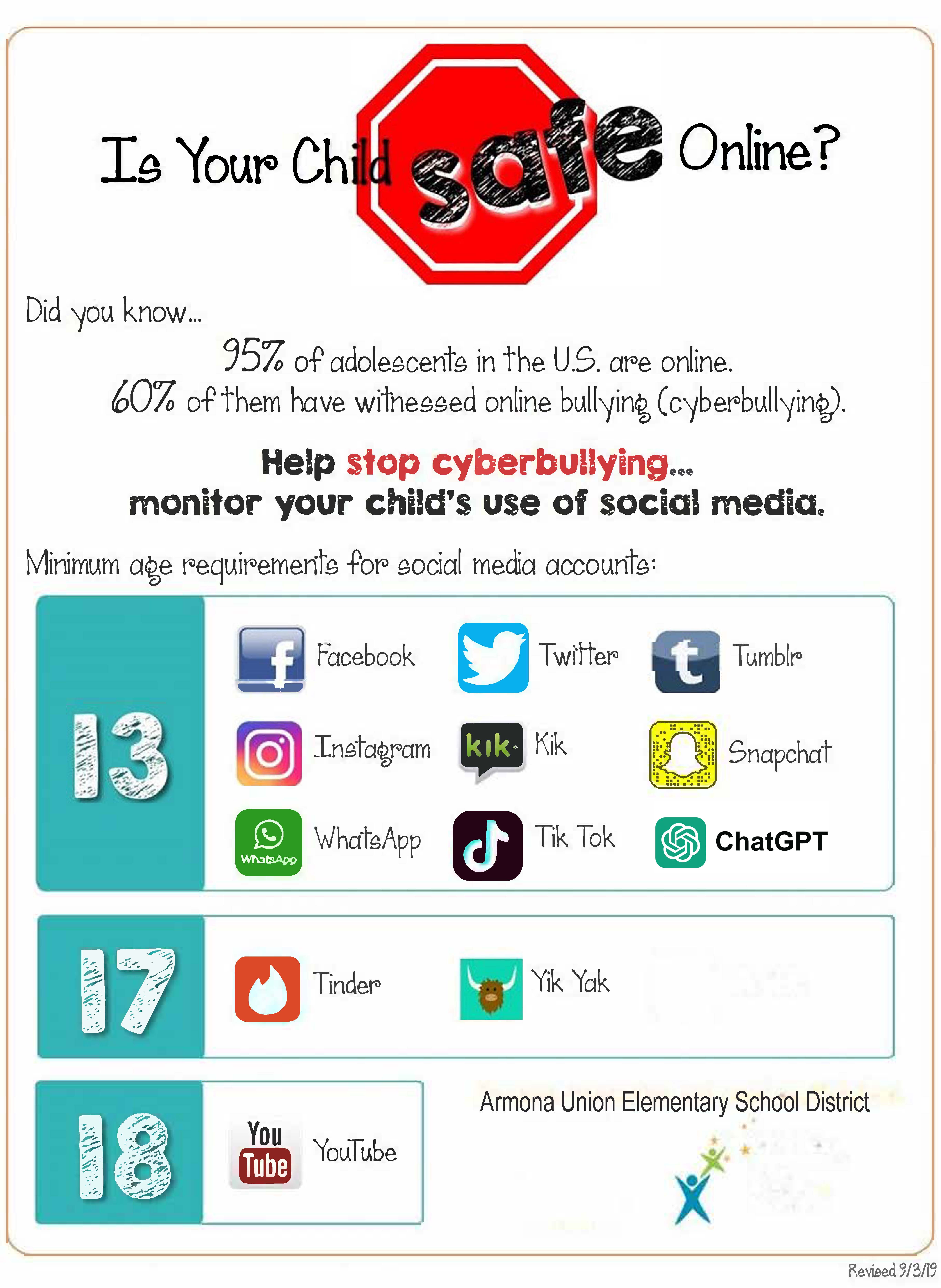
Minimum Age Requirements for Various Social Media Platforms:
Some platforms, such as YouTube, WeChat and Kik, have a minimum age required of 18, although kids aged 13-17 can sign up with parent’s permission.